intro
Hello, once again! It’s been a month since the last update, so here we go.
Good news, there is active development of the virtio sound driver for Haiku.
Key progress includes assigning channel maps to their respective streams and
integrating PCM stream scanning.
Additionally, efforts have focused on modularizing the driver, ensuring
compliance with Haiku’s coding standards, and laying the groundwork for further
enhancements to functionality. While progress has been substantial, there are
still areas requiring refinement as we continue to expand the driver’s
capabilities.
This report covers hrev57720 through hrev57753.
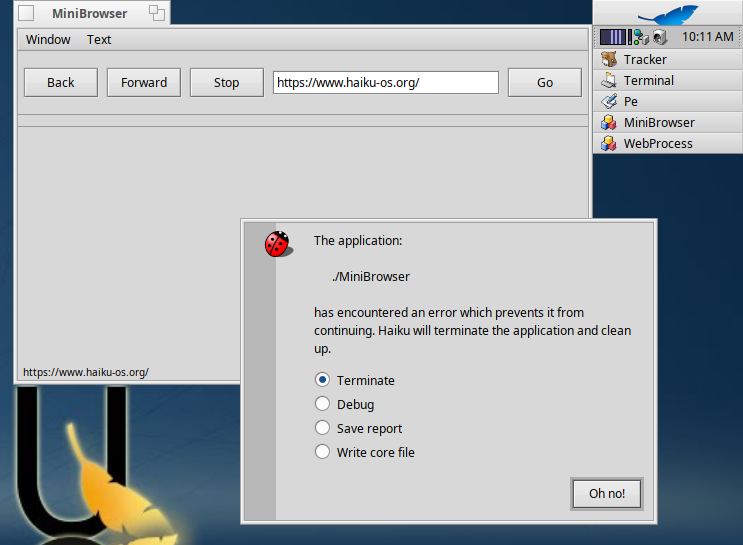
Currently, MiniBrowser (the simple browser that we use to test WebKit2) crashes rather easily. It crashes when it is closed, but that’s not too bad. Unfortunately, it also crashes when trying to navigate to a website (shown above)! I will be working on fixing this crash first.
For those who aren’t familiar with WebKit’s code, that’s all I can really say. But if you are familiar, then keep reading. WebKit wants to know how I will fundamentally approach porting WebKit2.
short whoami
Hello! I’m Diego Roux, an undergraduate engineering student at Universidad
Iberoamericana (Mexico). Passionate about low-level stuff, OS/kernel dev,
embed libs, and more!
I’m grateful to be working under Haiku for this GSoC! So, I’ll be working
to add support for sound virtio, enhancing virtualization by working with
the VM.
I’ll be under the guidance of
@Korli. Thanks! :D
brief intro + my plans
Whenever we boot a VM with Haiku in it, it needs to ensure we have a proper
environment, emulating all physical devices we require (e.g. ethernet, sound,
video, graphics, etc); great, isn’t it? we have everything nearly as we
would on actual hardware, but as with all great things in life, this comes
with a downside, emulation is (for our purposes) computationally expensive
(not really, but it does add some unnecessary overhead).
WebKit builds can take a lot of space and time to build on Haiku.
To those working on WebKit, welcome! This blog post is primarily for those working on HaikuWebKit, Haiku’s fork of WebKit, but it may also be useful for you.
I will be covering some techniques that are useful to reduce the size of build files without significant disadvantages. I’ll also cover how to speed up linking.
Introduction
Hey There!
My name is Calisto Abel Mathias, and I am excited to introduce myself as a first-year undergraduate student at the National University of Technology in Karnataka, India. I am honored to have been accepted into the Google Summer of Code (GSoC) program for 2024 under the mentorship of the Haiku project. A huge thanks to my two mentors - Niels and Humdinger for embarking on this journey with me.
This report covers hrev57680 through hrev57719.
Introduction
Hello again! I am Trung Nguyen (a.k.a @trungnt2910). You might
have already known me as the maintainer of the
.NET 8 Port for Haiku since last year’s GSoC program.
I am delighted to be accepted into GSoC again! This year, under the guidance of
@waddlesplash - one of the experienced Haiku devs
that I admire the most, I will work on one of the core issues of software development on Haiku: the
debugging experience.
Introduction
Hi there! I’m Daniel Martin (aka dalme) and I’m a final year undergraduate student
at Complutense University of Madrid (Spain). I’ve been accepted into Google Summer of
Code and I’ll be working to bring hardware virtualization to Haiku, a project that
has been in the GSoC ideas list for around a decade. I’ll be mentored by scottmc and
waddlesplash.
Project overview
QEMU is a virtual machine which allows running an operating system inside of another.
While there already is a Haiku port, it currently does not support any acceleration system
through native virtualization (through Intel VT-x and AMD SVM). This makes it too slow for
many uses, due to having to emulate the guest OS on software. Fixing this would allow Haiku
users to run another system, such as Windows or Linux, at almost native speed. This
would make using Haiku as primary operating system a viable approach for more people
since they could effectively run applications that are not yet available on Haiku.
So I got accepted into GSoC again! I’m going to be working on WebKit2. But what is WebKit2, or even WebKit, for that matter? Well, WebPositive uses WebKit to render its web pages. Currently, we use the WebKitLegacy API to communicate with WebKit. It would be nice to switch to the newer version: WebKit2. However, our port of WebKit2 still needs work. At present, it has lost its ability to even render any webpage at all! So, getting WebKit2 to work will be the primary goal of my GSoC project. If there’s time left, I might be able to integrate it into WebPositive.