We want news!
… or at least I suppose that some people want to know the progresses made on the WebKit port.
I think that we can split this work in two parts:
- Improvements made on the port.
- Landing in the official WebKit tree.
Ryan and I thought that the first part would have been a bit easier, but in fact since the previous port (by himself), many code in WebKit has changed. It is still a work-in-progress but I made some good advances.
As for the second part, it is also something that we are still working on. I can say that it is in great shape to be complete before the end of summer. ( The summer ends on the 21th of September… ;)
The end of GSoC is in less than two weeks now, so it's time to clean things up and get what I started working. I spent the previous week reading ICU documentation to understand how it worked, and this week I used this information to build the locale preflet.
This is not as simple as it looks. First, I had no experience of programming with the Interface kit so I had to learn how things worked. I also had to modify some of the Locale Kit API to be able to actually change some things that were read-only. Finally, the preflet is also the first application using the date and time formatting part of the locale kit, which was not written yet. I had to both make the API work and make it configurable.
After I didn't write the promised report on the last Coding Sprint which took place after BeGeistert in April, I am now trying not build up an even bigger lag. Last week, Axel and his girlfriend Claudia hosted Michael, Ingo and myself at their nice home in Hannover, Germany. Oliver could sadly not attend our small, relatively spontaneous and informal Coding Sprint due to sickness, although he seemed to be with us in spirit considering all his ICU commits. (The ICU libraries are an important foundation of the forthcomming Haiku Locale Kit.)
So far, I have been working on the indexing part of Beacon, which is nearly complete. In the coming weeks, I will be running beacond (now index_server) as a service in the background so that I can find and squash whatever bugs remain in the code. For now, index_server is blazing fast, but that might be because the indexes I test against are just a few megabytes in size. From what I hear, though, CLucene can easily handle indexes which are several gigabytes in size without blinking an eye, so speed might not be an issue as the indexes grow. Anyway, any potential performance bottlenecks will only show themselves once people start using index_server regularly.
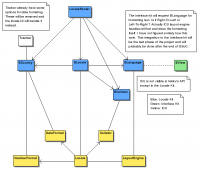 Locale Kit Interfacing with ICU
This week two important things happened for my GSoC project: I got commit access to Haiku and I finished working on the catalog part. This mean I can now work more efficiently without having to send my patches trough the GSoC mailing list (you may have noticed I still need my code to be reviewed, however :/).
The catalogs allow strings in an application to be translated. At a first glance you may think this is the only needed thing in a Locale Kit and my work is finished, but it is not the case. The first missing part is the preflet allowing you to select your favorite language. The locale kit will now always try French, if not found default to German, then finally to English. I think this is not the setup most of you want to use.
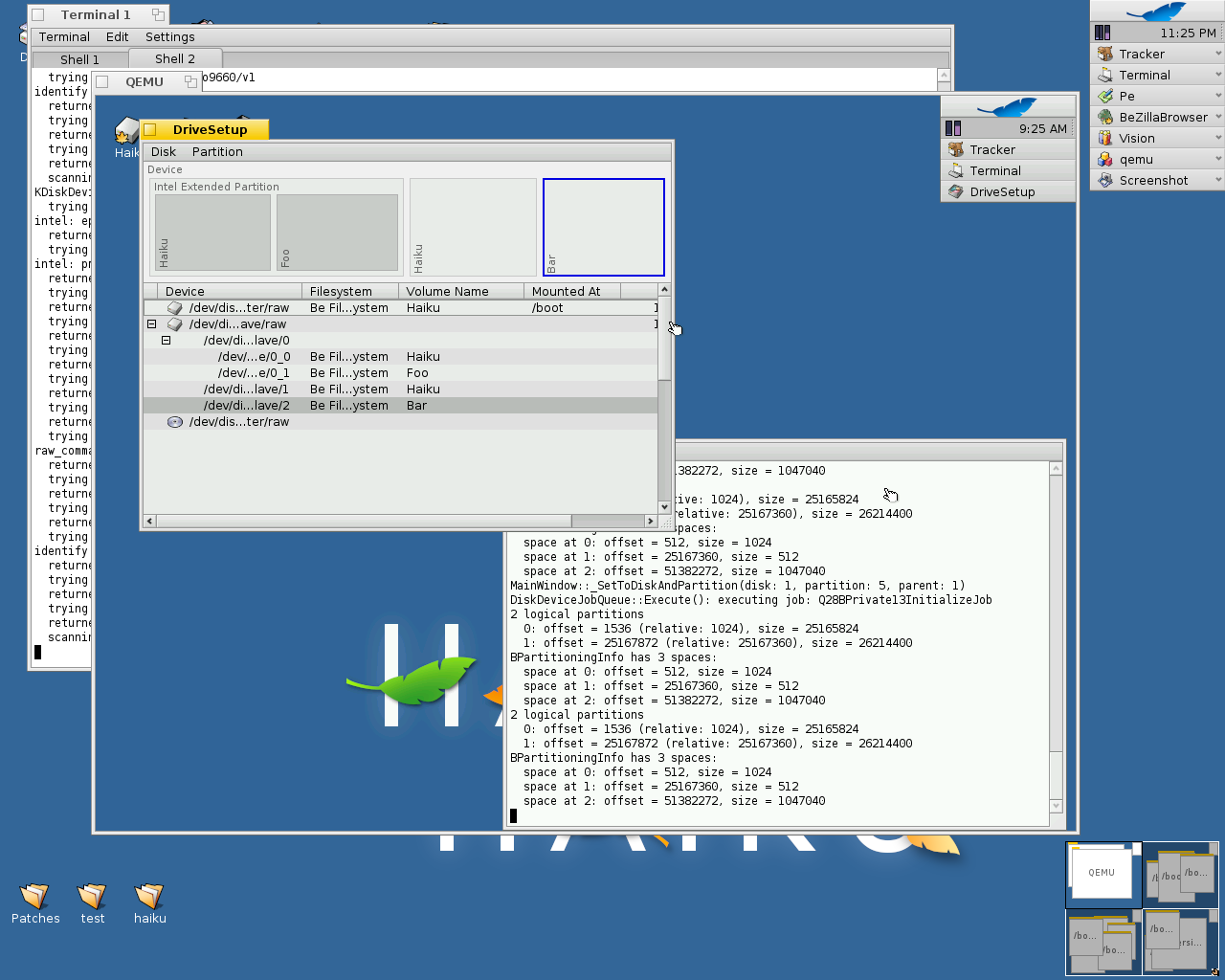
 DriveSetup with extended partitions I few days ago a patch went into the tree that cleaned up most of the remaining issues with creating primary partitions. So I started working on getting extended partition support in DriveSetup. This has been an interesting task as the extended partition support is not nearly as complete as primary partition support. To make a long story short, I have been able to create an extended partition and logical partitions within. This code is just a hack at the moment and not fit for the public but hopefully in the coming days the code can be cleaned up and the bugs can be fixed and we will have extended partitions! For those of you who are like me and enjoy seeing pictures here is a screen shot.
Ciao,
Bryce
DriveSetup with extended partitions I few days ago a patch went into the tree that cleaned up most of the remaining issues with creating primary partitions. So I started working on getting extended partition support in DriveSetup. This has been an interesting task as the extended partition support is not nearly as complete as primary partition support. To make a long story short, I have been able to create an extended partition and logical partitions within. This code is just a hack at the moment and not fit for the public but hopefully in the coming days the code can be cleaned up and the bugs can be fixed and we will have extended partitions! For those of you who are like me and enjoy seeing pictures here is a screen shot.
Ciao,
Bryce

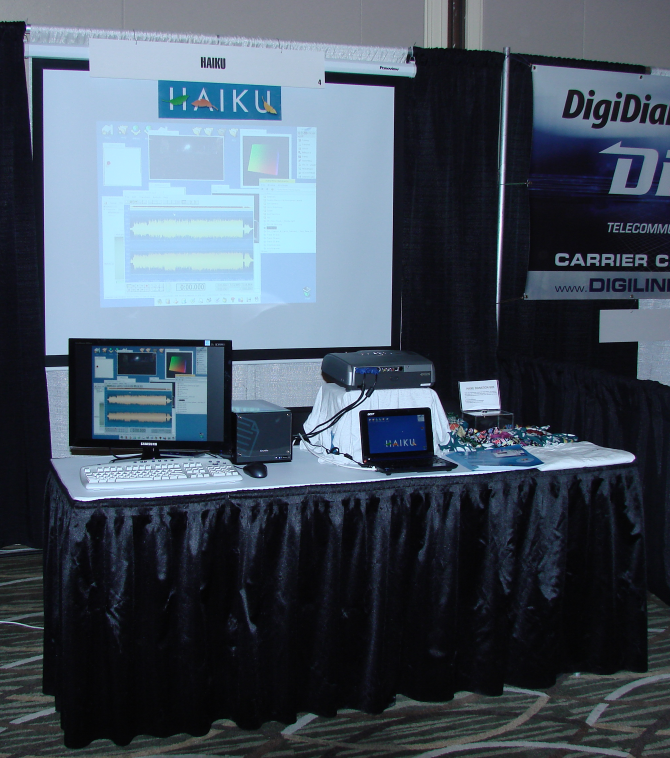
As some of you may have noticed under the Upcoming Haiku Events box on the front page, Haiku is making its debut at the upcoming O'Reilly Open Source Conference this week. Also known as OSCON 2009, this conference will be held at the San Jose McEnery Convention Center (Google map) from July 20th through the 24th. Haiku will be exhibiting along many other Open Source orgs on July 22 and 23; our booth number is 14; to locate us in the exhibit hall, check out the floor plan (138KB PDF).
During the two days of the OSCON exhibits, Scott McCreary, Urias McCullough, and myself plan to demo the latest nightly builds of Haiku, introduce newcomers to our project and operating system, and ask answer (duh!) any questions that visitors may have about Haiku. For demo purposes, we have prepared a cube-style desktop PC that will be hooked to a projector (similar setup from the SCaLE 2009 conference), an Acer Aspire One netbook and a possible an additional laptop computer. We will also have Haiku flyers at hand.
Hi guys.
Sorry for no update in the previous weeks.
I’v made some progress. mDNSResponder, which provides the underlying ZeroConf functionalities, has been ported to Haiku. It runs on Haiku correctly. In order to make it run, minor updates in our network stack were also applied.
I’m currently working on the service browser. It is almost finished. I’m also trying to write some wrapper classes so developers who need ZeroConf features can easily use them. And my mentor Axel is working on an update to our DNS resolver. After the update we will write some code that can resolve “.local” domains. So in the future you can directly type “http://webserver.local/" in your Web browser. Without any configuration it will resolve it and take you there.
After much effort from my GSoC student Maxime Simon and plenty of gentle coaxing from WebKit reviewers, I’m proud to announce that the various patches to add support for Haiku as a platform in WebKit are now being committed!
Maxime took my code from the original Haiku port I made in 2007 and updated it for the latest WebKit, which changes a lot daily, so you can imagine the state of the port after a few years! Still it was good to see that my previous effort was not to be wasted and it did not take Maxime long to start posting bugs and patches at the WebKit Bugzilla site.
This is a sample of the CSS styles taken from the extraordinary work done by Humdinger on the Haiku User Guide. I am showcasing these here because I would like to use them throughout haiku-os.org as well. If it turns out that there is no unsurmountable opposition to adopting these classes, I will eventually document them so that they can be used by those submitting news, blogs posts and documents to haiku-os.org.
Boxes
This is just a very unthreatening little note. Don't be upset.
This may have serious consequences. Don't mess this up.
By golly, you better be sure what you're doing! Danger, Will Robinson!