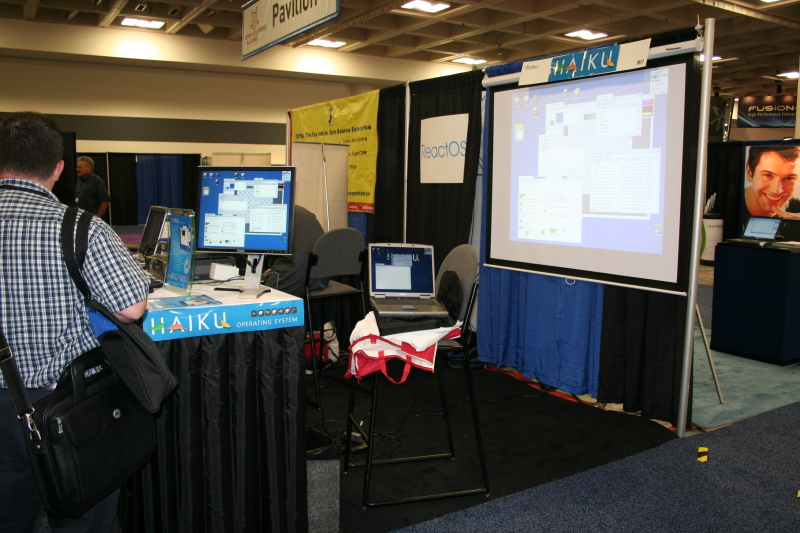
Trekking back to the Moscone Center
 Haiku Booth - Day 1
At 8:15AM, my sister gave me a ride over to the Moscone Center. We picked up Art Yerkes (from ReactOS) on our way, and proceeded down to the exhibit floor once we got there.
We arrived an hour early, and started with a few finishing touches on the booth. I think it turned out pretty well :)
 LinuxWorld Day 0
I set out on my 3+ hour trip to San Francisco at 9:30AM the morning of August 4th. My trip included stopping and picking up Jorge Mare (a.k.a. Koki) during my drive along with the rest of the supplies and equipment that he was providing for the event. My car currently has no air conditioning, and the majority of my trip was in 95F (35C) heat - so I was quite sweaty when I arrived at Jorge's house.
As the m68k port is getting shape, maybe some of you want to give a hand, so here is how to set up the environment. After explaining the choice of the target platform we’ll start with the build system, then the emulator to debug on the chosen platform.
Time for a quick update.
As with r26676, a first buggy xsi semaphore implementation is now present in Haiku (buggy because there is another patch waiting to be reviewed and commited that fixes some issues, but there might be some more coming).
It is now possible to download, compile and run the file system benchmark suite bonnie++. The version I've used is 1.03d, which has been suggested by the author of the suite. With this suite it is possible to test the file system implementation, plus the way Haiku works under low memory and heavy I/O operations.
Unlike BeOS, our kernel includes some pieces of C++ code, which sometimes give a headache when it comes making sense of a stack crawl from the kernel debugger, since symbols are mangled when linked into binaries, which means we must Decode__12CrypticCNamesPCc. I recalled seeing some gcc4 private API to demangle symbols into human-friendly names, but the code doing that, from libsupc++, has been written without concern for the inhabitants of the Kernel Debugging Land, using calls to malloc, realloc and free... But I still wanted to get nicer names, so I didn't give up. I also wanted to be able to get assembler dumps since not everyone has a serial cable to make use of the gdb stub.
 Code_Swarm for Haiku video
Today I received an email from Fredrik Holmqvist (TQH, of Bezilla fame) about a video that he recently created and posted on Vimeo. Titled “Code_Swarm for Haiku,” this is a video generated using Code_Swarm, a technology that allow visualizing the activity on a software repository. The video that TQH created was generated from the Haiku subversion commit messages, and shows the period starting from the time Haiku moved to Subversion up until revision 26538. Check it out here; it’s recommended that you watch the HD version in fullscreen. For those who don’t have or want to use Flash, you should also be able to download the source video (1280x720) from Vimeo (account required).
Another few weeks have passed since my last update, so here is another short report on the status of my project.
I hope everyone is enjoying the results of my work that have already been integrated into the main source trunk. Now I am pleased to announce that also the second part of my project is almost finished.
Someday I should write about the start of the 68k port, there is plenty to talk about…
Today^Wnight^Wmornin erh, hmm well, now, I’ll try to do a live report on the issue I left you with last time: getting the kernel to load correctly.
I’ve been getting further recently on the 68k port, as you may know already everything now compiles but the kernel is still largely stubbed, misses drivers, and the bootloader doesn’t load it yet.
I’ve almost finished mmu setup, at least for the 040 ARAnyM emulates.
Been quite busy those days, but I wouldn’t forget to report the remaining days at RMLL… more people, talks, and RMS of course!