As I write this first post, I’m in the process of sending off the initial OpenJDK project page content to Mark Reinhold for public posting. I’m grinning wildly, and I’m having some great flash-back style memories of working on the JDK 1.4 port.
I think now is a good time for a general status report, to communicate where we’re at, where we’re going, how we’ll get there, and how you can get involved.
To be honest, I was a bit desperate in the run up to BeGeistert 018. The fact that most of our core contributors were present gave me high hopes for a good push of Haiku development. Since my laptop was stolen, which was a really solid Haiku machine, I could not run Haiku natively on my main development computer. Even on some older computers I had, I could not run it anymore since the initial changes to the IDE stack. Next was the fact that I bought a new USB based KVM switch. The only USB stack with which I had a working keyboard and mouse was the original Dano stack. And even then I sometimes lost input when switching back to BeOS from another computer. With Haiku, the input devices were not working at all. So I was packing both my computer, monitor and the KVM switch for BeGeistert, all in all, it was quite a load. I was heading towards BeGeistert with a bit of mixed feelings, because Haiku wasn't working so well for me anymore and I didn't know if it was going to be fun only or with some disappointments mixed in.
i’m going to miss those of you at Haiku who are moving on. i’m in a dark time of my life, maybe the end, and i revisit the old good times now and then and BeOS is one of the bright, shining gems, despite the bittersweet facts of how it all went down.
i’m still breathing at the moment. i still run BeOS (GoBe Productive owns all my writing ;-) and i could use tips on getting out of the DNS nightmare i am having with Verizon and BeOS Pro R5.0.3 … :-(
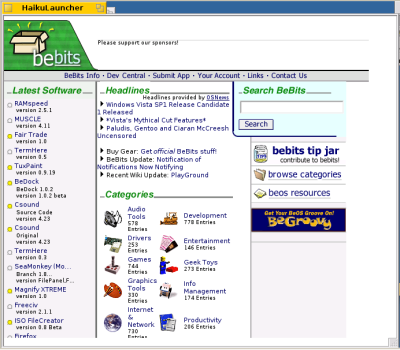 Webkit rendering bebits.comIt looks like the Haiku Webkit port initiated by Ryan Leavengood has entered a productive second stage of development, and thanks to the recent work by one of the new project team members, Andrea "xeD" Anzani, tangible progress has been made as shown by the recent screenshot showing the HaikuLauncher application rendering bebits.com (shown to the right). I was curious about his work, so I went directly to the source and asked a few questions to Andrea; here are his answers.
Andrea: From the questions you wrote, it looks like you think we have a working browser here. Well, we don't. I'm sorry to tell you but what you see it's just a proof that the webkit is working. Still incomplete and with a lot of bugs. The webkit is, in short words, a framework for loading, parsing and drawing an html page (including net connections and javascript interpreter). We are working on fixing and finishing it. When we are done with porting the webkit, then we can speak about the development of a web browser.
The WebKit Haiku port team has seen some nice progress lately in the form of our first decent rendering. Read more to see it...
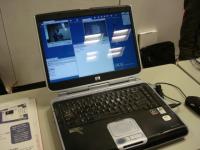 Demo machine at KOF Haiku boothNot surprisingly, it took me much longer than originally planned to find the time to write about the second day at the Kansai Open Source Forum conference (KOF). But no worries: memories are still quite fresh, as it's usually the case when things go well and you have fun. The second KOF day started earlier, especially for me. The exhibits were scheduled to open at 10:00AM, so with Momoziro we decided to meet at the hotel lobby at around 9:00AM. But I was up way before that, at around 5:30AM (compliments of my very jet-lagged old body). So I sat in front of my laptop to write some emails and then went through my Haiku presentation slides again, making little changes here and there, changing the order of a few slides and even adding a couple of slides based on some of the questions that I had received during the first day at KOF.
I know I have been very quiet for a while in regards to my Haiku WebKit port, but that is because I’ve been in a long session of coding. I am happy to report that this weekend I finally got WebCore compiling for Haiku:
Link ../../../generated/objects/haiku/x86/release/WebKit/WebCore/libwebcore.so
Chmod1 ../../../generated/objects/haiku/x86/release/WebKit/WebCore/libwebcore.so
SetType1 ../../../generated/objects/haiku/x86/release/WebKit/WebCore/libwebcore.so
MimeSet1 ../../../generated/objects/haiku/x86/release/WebKit/WebCore/libwebcore.so
SetVersion1 ../../../generated/objects/haiku/x86/release/WebKit/WebCore/libwebcore.so
So what does this mean? Does it mean the port is now complete? Unfortunately, no it doesn’t.
This past Friday and Saturday I attended the Kansai Open Source Forum (KOF) conference in Osaka, Japan, to represent the Haiku project together with my Japanese friend and BeOS/Haiku developers Momoziro-san. Here are my impressions from the first day at KOF.
 ATC complex in Osaka, where the KOF conference was held.
KOF was held at the Asian Trade Center (ATC), located in the waterfront area known as the Osaka Bay Area. ATC is a huge complex of which the KOF exhibit area was only a very small part; the complex has a lot of stores and space for various types of events that are held on a regular basis. Ironically, the KOF exhibit floor was on an area of ATC called the MARE Gallery; I say ironically, because as some may know, Mare is my last name. That and the fact that Japan is like my second home (I lived there for about 23 years) kind of made me feel welcome. ;)
A few hours ago I had my Haiku talk on the Dutch Open Source event T-DOSE, and I’m still glowing all over. The attendence was above all my expectations, around 25 people were in the room. And despite of the last minute all night changes I had to make, the speech went fluently. Someone made a few pictures, which I hope to be able to post soon, and more importantly, I’m on tv! I’m on Sunday around 11 AM, so have a look!
Excuse me for the brevity of the previous post, it was done on my mobile phone (per experiment), and thus I was limited in the amount of characters I could post.
I just returned from Eindhoven (which, by the way, is the most ugly city in the Netherlands), and all in all I had a fun day. I went to see two talks: one on KDE 4 programming by Adriaan de Groot. I met him six years ago, when I was part of the Dutch translation team and we celebrated five years of KDE. He announced technologies, that for us as Haiku lovers, weren’t all that new. For example: finally KDE introduced Thread Weaver, an API that provides a job-based interface to perform tasks in threads. Of course, since X is always limited to the single-thread event model, this still makes the GUI run in a single thread. He also introduced an API to play sound files with three lines of code. We already have that one! Seriously though, it was nice to see some of the cool things such as Sonnet, an integrated spell checker that is applied to almost all text input, and Solid, an abstraction for hardware. Whilst this is extremely useful for KDE, since it runs on many platforms, the cleanliness of the API (on first sight) might provide some interesting ideas for Haiku as well.