I have been documenting my progress on porting the WebKit project to Haiku on the Haikuware site, but decided to also post information here. You may want to read my previous blog article about this port and also the information at the WebKit bounty on Haikuware. Please consider donating to a bounty.
Before I started work on this port I asked in the #webkit IRC channel what the mimimum version of GCC that was required to compile WebKit. The general consensus was 4.0. So what does that mean?
Whenever I was with Axel and saw Haiku running on his IBM ThinkPad T40p, I was almost convinced, that he must have forgotten to commit a rather effective patch, though he swore that that was not the case. I have never seen the app_server perform so well on any other machine.
My backpack turned out really heavy, because at the moment, I have no mobile computer. Luckily I have one of those "industry embedded" machines, as big as an external CD-ROM drive. But I still had to pack my 17" flat screen. The travelling by train was nice, although I almost got off at the wrong station in Basel. I mean, I did get off, but I got back in in time... turned out Ingo did it exactly as I before me. He, François and Michael Lotz were already there, and they waited at the train station to pick me up. They held up a paper with the Haiku logo, as if I wasn't going to recognize them... :-) One hour later, we picked up Axel, again with the help of the Haiku sign.
Haiku Admin Meeting 2007-07-23:
- A quick GSoC status was discussed.
- It was agreed that having Axel and Ingo working together in the same location to focus on many of the VM and stability issues was a successful endeavor:
It was proposed that this be done more often, with possible sponsorship from Haiku, Inc. to pay for costs whenever possible.
It was agreed that Axel and/or Ingo will be reimbursed for any expenses that were incurred.
This type of reimbursement support would only be reserved for certain situations deemed suitable by Haiku, Inc.- The state of Haiku after the recent work by Axel and Ingo was discussed:
It was observed that the system is very stable at this point, even more so than was anticipated.- The possibility of WalterCon cancellation is discussed:
Only 3 confirmed sign ups so far.
Most likely reason for low attendance is probably due to short notice.
Another likely reason mentioned is that most of the user/fan base is spread across so many countries.
Planning for next year is already under way, and the short notice and planning problem should be prevented next time around.
If only 3 people register, it's not worth running the event.
Even if canceled, Michael Phipps should probably still go to LinuxWorld to do the presentation as planned.- More discussion about bounties and raising funds took place:
It was mentioned that providing targets for raising funds will help people donate to specific causes.- More admin team changes:
Michael Pfeiffer and Waldemar Kornewald have stepped down.- It was recognized that "diver" has been extremely active on the QA side of things recently, and his efforts are appreciated.
That wraps it up for the July 23, 2007 meeting.I would like to remind readers that any official discussion about the decisions made by the Haiku Admins should be directed to the General Mailing List. Any mistakes in this summary may be posted in the comments if desired or you may use my contact page.Haiku Admin Meeting 2007-07-02:
- Discussion about WalterCon planning. Things are moving along.
- The existence of a project called RadiantOS which claims to eventaully be a "distro" based on Haiku was mentioned.
- There was some discussion about the status of running GCC in Haiku:
Haiku might be close to self-hosting capability (able to build itself).
It was mentioned that once Haiku can self-host it's probably time for an official alpha release.
Haiku Admin Meeting 2007-07-09:
- There was some discussion about AGG and the recent buzz about it on OSNews and other places.
- The Admin Team Gathering was discussed some more.
- Some WalterCon issues were discussed:
The registration module on the WalterCon website appears to be broken.
There is a need for more presenters.- Some progress is being made on the x86-64 build-environment issues.
- The ability for Haiku to self-host was discussed further:
Axel and Ingo will take a look at the VM issues.- GSoC progress was discussed:
Lots of good results from the participants are already surfacing.
End of July 2, 2007 and July 9, 2007 meetings.I would like to remind readers that any official discussion about the decisions made by the Haiku Admins should be directed to the General Mailing List. Any mistakes in this summary may be posted in the comments if desired or you may use my contact page.Even though I had some private issues this week, all is going well with the PackageInstall. In its current form it is able to properly install all 3 test BeOS packages I tried on it, creating files and directories along with their data and attributes without flaw. So, what’s left to do right now?
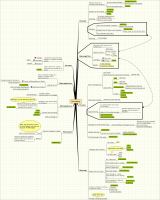
For the API Documentation team I’ve prepared an overview of the messaging functions in the Application Kit, mind map style. This image should be the guide to writing the actual API documentation.
Please redirect comments on the technical content to the haiku-development list. They are highly appreciated!
A couple of articles I just read (here and its rebuttal) are written by Linux users about why Linux is the best and how to get a regular person (hereafter referred to as Joe User) to start using Linux. To save you the time of reading the two articles, the first is entitled “Understanding the Common User: Everything should be as simple as it is, " by Keyto. The article is partly about how a Common User thinks, but primarily that quite a lot of the problem with Linux is the current users – geeks who have trouble relating to Joe at Joe’s level of expertise instead of the geek’s level. The rebuttal “Get Real or How NOT To Convert Your Grandma to Linux,” by Karol Trojanowski, advises that Linux users shouldn’t try to “convert” everyone and why. A quote from the article describes Linux perfectly: “A wand does magic in a wizard’s hand. Otherwise, it’s just a stick.” All too true. Many of the problems that Linux advocates face are the same ones that BeOS proponents struggle with. The first step to effective persuasion is understanding the audience, so who exactly is Joe User, anyway?
Haiku Admin Meeting 2007-06-18:
- Discussion about some "missing" articles on the new website - specifically old newsletters. Also desired is a way to make them easier to locate.
- Mention of the continual "browser for Haiku" topic that pops up in the mailing list and elsewhere. An official decision should be discussed and published. It may be still too early to fully decide on a direction.
- More discussion took place about a potential physical "admin gathering" in the near future.
Haiku Admin Meeting 2007-06-26:
- Darkwyrm has been working on the WalterCon 2007 details including some content. Some ideas were discussed.
End of June 18, 2007 and June 26, 2007 meetings.I would like to remind readers that any official discussion about the decisions made by the Haiku Admins should be directed to the General Mailing List. Any mistakes in this summary may be posted in the comments if desired or you may use my contact page.Haiku’s network stack follows a top-down approach with clear boundaries, pure object oriented design. However, TCP/IP protocol stack was designed more than 30 years ago with different idea in mind. It’s mostly speed, fast processing and stability that designers were looking for back then. That’s why many boundaries in the TCP/IP protocol suite design are blurred somehow.
Basic hierarchy is established. Datalink layer protocol (Ethernet, PPP, etc.) is followed by a Network layer protocol (IP), which is followed by a Transport layer protocol (TCP, UDP, SCTP, etc). Those protocol often need to interact besides the limits of data transfer between two endpoints. Congestion control, error reporting, information exchange is needed. And with one exception (TCP) protocols lack that functionality.